Disagreement Letter

=

Disagreement Letter for Person in Authority

August 5th, 2010  |  Published in Disagreement Letter

Writing a letter of disagreement can be hard because such a letter sometimes results in a negative outcome. But writing a letter to disagree with a subordinate, or superior, or a person in authority can be the best way to express concern over something that the person you’re writing to has done. It is expressing your concern or opinion in a constructive, but assertive way. You write such a letter to recognize and state a problem while explaining what you want the recipient to do about it.

Letters of disagreement can be a perfect tool to correct a misunderstanding. An effective letter of disagreement clearly states the issues and reasons for disagreeing with the recipient’s point of view, as well as your proposed course of action. It is not, however, a medium to hurl accusations. The main purpose of writing such letter is to resolve a conflict or problem. The tone of this letter should still be courteous, and the format should be clear, concise and direct. Please be reminded to avoid threatening the recipient. Be direct, yet respectful.

Below is a sample of a letter of disagreement:

SAMPLE LETTER

June 11, 2010

Julienne Rogers
213 Anyplace Lane
Austin, TX 78750

Abby Campton
Business Development Manager
Project Management Department
Wrightway Systems
1810 Kramer Lane
Suite C-201
Austin, TX 78758

Dear Ms. Abby Campton,

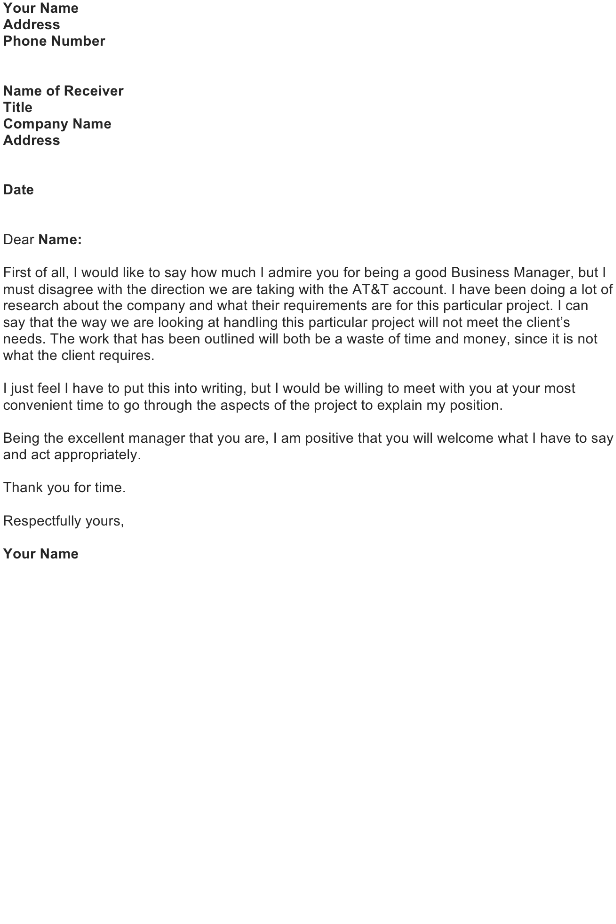
First of all, I would like to say how much I admire you for being a good Business Manager, but I must disagree with the direction we are taking with the AT&T account. I have been doing a lot of research about the company and what their requirements are for this particular project. I can say that the way we are looking at handling this particular project will not meet the client’s needs. The work that has been outlined will both be a waste of time and money, since it is not what the client requires.

I just feel I have to put this into writing, but I would be willing to meet with you at your most convenient time to go through the aspects of the project to explain my position.

Being the excellent manager that you are, I am positive that you will welcome what I have to say and act appropriately.

Thank you for time.

Respectfully yours,

Julienne Rogers

Letter of Disagreement

July 24th, 2010  |  Published in Disagreement Letter

In a workplace setting, disagreements between staff members are inevitable. In order to ensure that differences of opinion are expressed in a constructive manner, one of the parties should write a letter of disagreement to the other.

A letter of disagreement expresses the writer’s position on a certain issue in a positive manner without being confrontational. It is addressed to the particular individual with whom you have a difference of opinion. It should begin with the writer identifying the issue with which they disagree with the other party. They should then go straight into the reasons why they do not agree with it.

The tone of the letter should be professional and courteous, without any anger, name calling or uncalled-for accusations. The letter should also get straight to the point, and not include discussions of anything extraneous to the main issue. The letter could end with the hope that the two parties learn to respect the other’s positions on the matter at hand. Below is a sample disagreement letter that can be adopted to meet a writer’s particular needs.

SAMPLE LETTER

August 14, 2010
Max J. Carver
Head, Human Resources Department

Bill Jackson
Vice President for Operations

Subject: Daycare for Employees

Dear Bill,

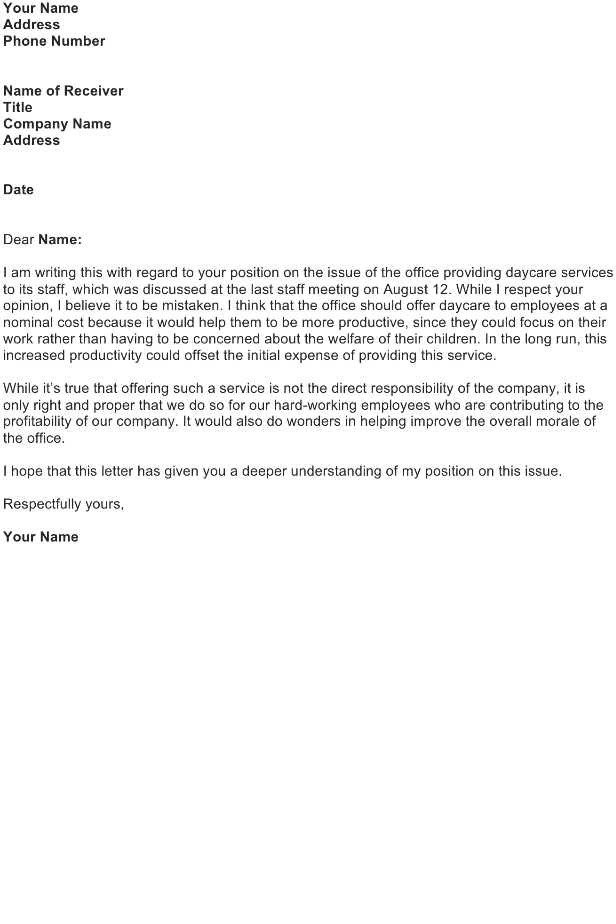
I am writing this with regard to your position on the issue of the office providing daycare services to its staff, which was discussed at the last staff meeting on August 12. While I respect your opinion, I believe it to be mistaken. I think that the office should offer daycare to employees at a nominal cost because it would help them to be more productive, since they could focus on their work rather than having to be concerned about the welfare of their children. In the long run, this increased productivity could offset the initial expense of providing this service.

While it’s true that offering such a service is not the direct responsibility of the company, it is only right and proper that we do so for our hard-working employees who are contributing to the profitability of our company. It would also do wonders in helping improve the overall morale of the office.

I hope that this letter has given you a deeper understanding of my position on this issue.

Respectfully yours,
Max J. Carver
VP Operations