Memo

=

Advice to Subordinates Memo

October 23rd, 2010  |  Published in Memo, Memorandum

A letter from a company officer giving advice to a staff member is usually written when the officer sees that a particular employee needs more guidance from their superiors in the performance of their duties. It can either offer corrective advice to staff members doing a certain task or give suggestions on how a particular job can be performed in a better manner. The most important thing to remember about this type of letter is that its ultimate intention is to help the employee improve their work performance, not to scold them or take them to task for perceived shortcomings.

The essential elements of this type of letter are the identification of the particular duty or task that needs improvement and the advice being given by the letter writer. It can begin with the writer assuring the employee that they are generally satisfied with their performance, and then continue by saying that however, they have noticed the following areas that could use some improvement. The rest of the letter then gives their advice on how to effect the improvements. The tone of the letter should be professional but not too formal, as the writer does not want to make the employee feel bad.

Below is a sample of a letter in which a supervisor gives advice to an employee.

Sample Letter

April 10, 2010

Nelson and Sons
Washington, D.C.
email@server.org
www.address.org

Janet Andrews
Logistics Department

Dear Ms. Andrews,

Greetings!
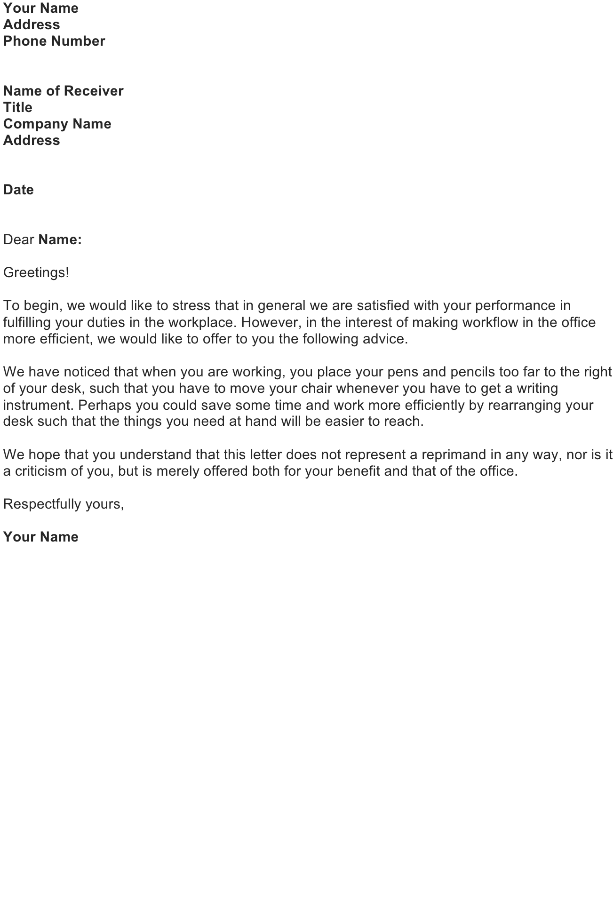
To begin, we would like to stress that in general we are satisfied with your performance in fulfilling your duties in the workplace. However, in the interest of making workflow in the office more efficient, we would like to offer to you the following advice.

We have noticed that when you are working, you place your pens and pencils too far to the right of your desk, such that you have to move your chair whenever you have to get a writing instrument. Perhaps you could save some time and work more efficiently by rearranging your desk such that the things you need at hand will be easier to reach.

We hope that you understand that this letter does not represent a reprimand in any way, nor is it a criticism of you, but is merely offered both for your benefit and that of the office.

Respectfully yours,

Randolph Stafford
Personnel Manager, Nelson and Sons

Memo Documenting Employee Reprimand

August 7th, 2010  |  Published in Memo

Any organization has policies on different aspects pertaining to office actuations. Part of a newly hired employee’s company orientation is the presentation of company house rules. All companies have policies on absenteeism, tardiness, proper office decorum, among others.

It is a requirement, with Human Resources Department taking the lead, to keep track of every employee’s performance record. This is considered as one of the basis for an employee’s promotion or termination. The immediate superior is tasked to document employee reprimands. As a supervisor, you monitor your subordinate’s performance and there are times that you will need to correct their behavior. Employees are given notification or citation of a wrongdoing. There are offenses that are considered cumulative; first offense – written warning, second offense – 3-day suspension, and so forth. The reprimand must indicate the signatures of both the recipient and the immediate superior.

Here is a sample of a reprimand letter.

SAMPLE LETTER

MEMORANDUM

TO: Name of Employee
Position
FROM: Name of Immediate Superior
Position
DATE:
SUBJECT: Final Warning

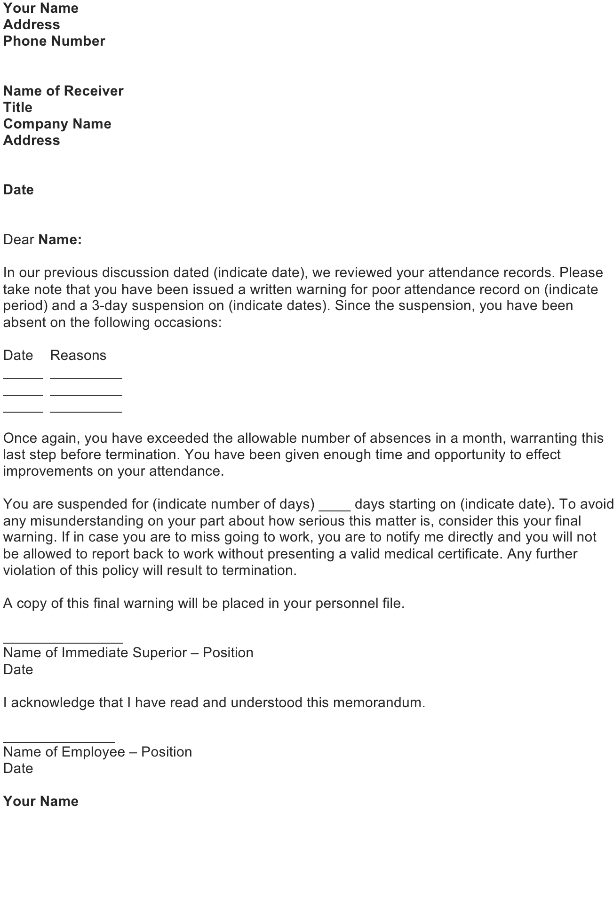
In our previous discussion dated (indicate date), we reviewed your attendance records. Please take note that you have been issued a written warning for poor attendance record on (indicate period) and a 3-day suspension on (indicate dates). Since the suspension, you have been absent on the following occasions:

Date Reasons
_____ _________
_____ _________
_____ _________

Once again, you have exceeded the allowable number of absences in a month, warranting this last step before termination. You have been given enough time and opportunity to effect improvements on your attendance.

You are suspended for (indicate number of days) ____ days starting on (indicate date). To avoid any misunderstanding on your part about how serious this matter is, consider this your final warning. If in case you are to miss going to work, you are to notify me directly and you will not be allowed to report back to work without presenting a valid medical certificate. Any further violation of this policy will result to termination.

A copy of this final warning will be placed in your personnel file.

_______________
Name of Immediate Superior – Position
Date

I acknowledge that I have read and understood this memorandum.

______________
Name of Employee – Position
Date

Policy Change Directive Letter

August 3rd, 2010  |  Published in Memo

A company’s policies are never set in stone, and occasionally changes need to be made to them to respond to particular situations, or new ones may need to be created. Employees may also have to be reminded of particular procedures, for example ones regarding safety, that they may have begun to neglect. To address this need, company officials may issue a directive establishing or changing company policies, or reaffirming existing ones. These letters may be sent to the particular employees concerned, to all staff members or be posted on a bulletin board for staff to read.

The essential parts of this letter include identifying the particular policy or procedure to be changed, reaffirmed or introduced, the rationale behind the changes, and the date when the policies will become effective. The tone of the letter is straightforward and informative, as well as being concise and to-the-point. It does not begin with a salutation, as it is not addressed to any particular person.

Below is an example of a letter issuing a directive to change, reaffirm or establish a policy or a procedure.

SAMPLE LETTER

Subject: Cost Saving Measures

To all Concerned Employees,

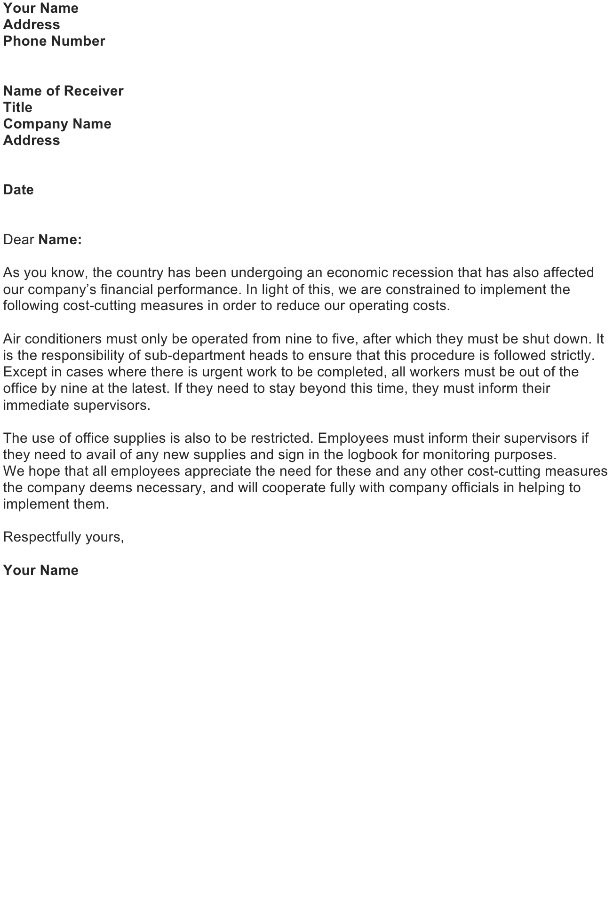
As you know, the country has been undergoing an economic recession that has also affected our company’s financial performance. In light of this, we are constrained to implement the following cost-cutting measures in order to reduce our operating costs.

  • Air conditioners must only be operated from nine to five, after which they must be shut down. It is the responsibility of sub-department heads to ensure that this procedure is followed strictly.
  • Except in cases where there is urgent work to be completed, all workers must be out of the office by nine at the latest. If they need to stay beyond this time, they must inform their immediate supervisors.
  • The use of office supplies is also to be restricted. Employees must inform their supervisors if they need to avail of any new supplies and sign in the logbook for monitoring purposes.

We hope that all employees appreciate the need for these and any other cost-cutting measures the company deems necessary, and will cooperate fully with company officials in helping to implement them.
Respectfully yours,

Ted Farmer
President, Sigma Corporation

Office Policy Change Memo

July 30th, 2010  |  Published in Memo

A company’s policies are never set in stone, and occasionally changes are made to them to respond to particular situations, or new ones may need to be created. Employees may also have to be reminded of particular procedures, for example ones regarding safety, that they may have begun to neglect. To address this need, company officials may issue a directive establishing or changing company policies, or reaffirming existing ones. These letters may be sent to specific employees, or just to be posted on a bulletin board for all the staff to read.

The essential parts of this letter include identifying the particular policy or procedure being changed, reaffirmed or introduced, the rationale behind the changes, and the date when changes take effect. The tone of the letter is straightforward and informative, as well as being concise and to-the-point. It does not begin with a salutation, as it is not addressed to any particular person.

Below is an example of a letter issuing a directive to change, reaffirm or establish a policy or a procedure.

SAMPLE LETTER

Subject: Cost Saving Measures

To all Concerned Employees,

As you know, the country has been undergoing an economic recession that has also affected our company’s financial performance. In light of this, we are constrained to implement the following cost-cutting measures in order to reduce our operating costs.

  1. Air conditioners must only be operated from nine to five, after which they must be shut down. It is the responsibility of sub-department heads to ensure that this procedure is followed strictly.
  2. Except in cases where there is urgent work to be completed, all workers must be out of the office by nine at the latest. If they need to stay beyond this time, they must inform their immediate supervisors.
  3. The use of office supplies is also to be restricted. Employees must inform their supervisors if they need to avail of any new supplies and sign in the logbook for monitoring purposes.

We hope that all employees appreciate the need for these and any other cost-cutting measures the company deems necessary, and will cooperate fully with company officials in helping to implement them.

Respectfully yours,

Ted Farmer
President, Sigma Corporation

Special Projects Memo

July 18th, 2010  |  Published in Memo

This letter is intended for employees who will be tasked to focus on reports and paperwork that need to be done immediately. This could be addressed to secretaries for additional administrative work that has not been tackled. This letter may also be used to inform the staff or subordinates about a new requirement for status reports.

SAMPLE LETTER

June 18, 2010

Ms. Olivia Devon
Communication Department
Westford University
2716 Mayfield St. cor. Westchester Ave.
Deerfield, Detroit 12345

Re: Logistics Paperwork for University Observation Routine

Dear Ms. Devon,

Greetings!

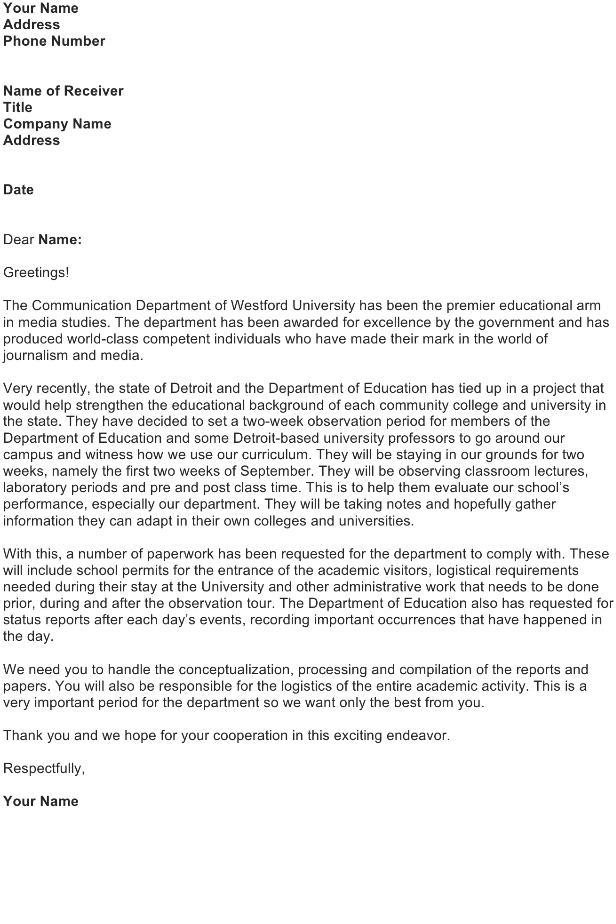
The Communication Department of Westford University has been the premier educational arm in media studies. The department has been awarded for excellence by the government and has produced world-class competent individuals who have made their mark in the world of journalism and media.

Very recently, the state of Detroit and the Department of Education has tied up in a project that would help strengthen the educational background of each community college and university in the state. They have decided to set a two-week observation period for members of the Department of Education and some Detroit-based university professors to go around our campus and witness how we use our curriculum. They will be staying in our grounds for two weeks, namely the first two weeks of September. They will be observing classroom lectures, laboratory periods and pre and post class time. This is to help them evaluate our school’s performance, especially our department. They will be taking notes and hopefully gather information they can adapt in their own colleges and universities.

With this, a number of paperwork has been requested for the department to comply with. These will include school permits for the entrance of the academic visitors, logistical requirements needed during their stay at the University and other administrative work that needs to be done prior, during and after the observation tour. The Department of Education also has requested for status reports after each day’s events, recording important occurrences that have happened in the day.

We need you to handle the conceptualization, processing and compilation of the reports and papers. You will also be responsible for the logistics of the entire academic activity. This is a very important period for the department so we want only the best from you.

Thank you and we hope for your cooperation in this exciting endeavor.

Respectfully,

Dr. Soledad Garcia
Dean
Department of Communication